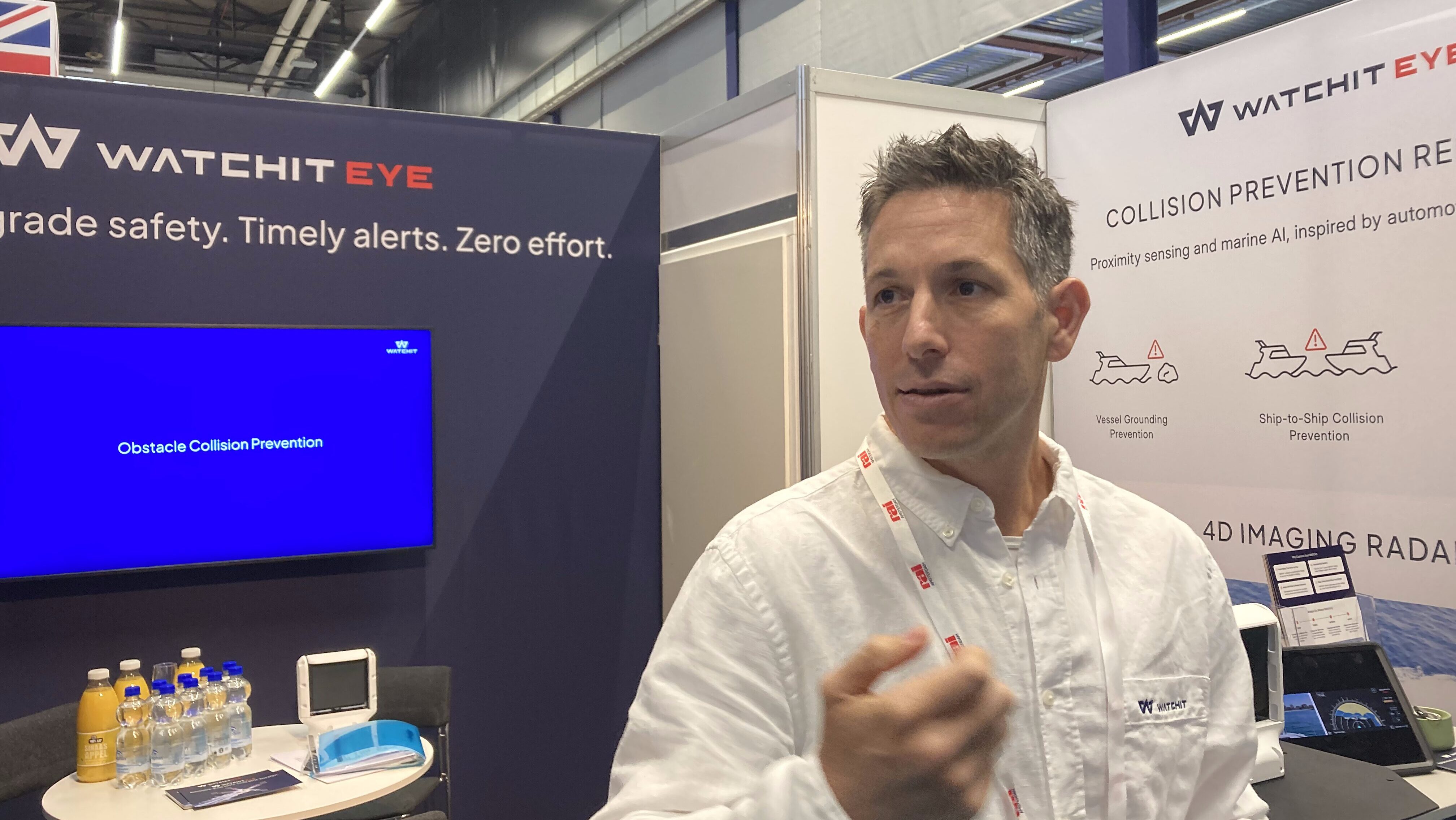
MIN sits down with Watchit’s CEO, Tal Duvdevany, at Metstrade to hear about the Watchit Eye and why the company is targeting OEMs.
Launching Watchit Eye — a proactive autonomous collision-prevention system for the marine sector that now incorporates an imaging radar — at Metstrade 2025, chief executive Tal Duvdevany can’t help referencing the automotive market. The system has essentially come from that market, and Watchit has adapted it specifically for recreational boat owners.
Watchit’s collision warning system sits in the background and pops up on the MFD whenever it thinks the helm could do with more focus on the task at hand to avoid potential hazards such as swimmers, kayaks and more. Duvdevany says the technology is particularly useful for owner-operated vessels in the eight to 20-metre range, where the owner must simultaneously navigate and enjoy the experience.
“Rather than focusing on distance, Watchit measures time,” says Duvdevany. “The system is designed to give enough — ten to 30 seconds — before something happens. This translates to a few hundred metres, but the critical point is that it provides enough time to respond based on the boat’s speed.
“This kind of proactive safety system is the future of the industry. In five to ten years, every boat in the world will have a system,” says Duvdevany.
He’s aiming to get the message out to as many boatbuilders as he can.
“We don’t go to the consumer,” he says. “Boatbuilders know their customers better than us, and that can be a benefit for our future.” As well as working with Azimut and Ferretti Group, the company is working “with several other smaller fast boats.”
Adapting automotive tech for the marine world
Like cars’ safety systems, Watchit operates without requiring constant user interaction. The technology consists of two main components: a core software layer that uses data fusion from charts, AIS, and GPS to identify risks, and a newly launched hardware component called the ‘Watchit eye’ — a 4D imaging radar adapted from automotive technology for marine use.
The system minimises human interaction in setup, learns user behaviour through cloud connectivity, and adapts to different vessel types and environments automatically.
Duvdevany says Watchit can detect various objects above water that traditional radars might miss, such as kayaks, small fishing boats, buoys, and jet skis. While it’s been trialled for man overboard (the system detected the volunteered engineer), it’s not the main objective. That’s focused on recreational ‘normal’ usage.

Limitations, realities and weather performance
While Watchit obviously watches for charted items (shallow waters), unexpected objects need to be at least 30-40 centimetres above the water for it to see them. That’s because it utilises radar (4D imaging – short distance, high frequency, and high resolution) and works in rain, fog, and at night. But Duvdevany points out, “it’s a good alternative for smaller boats that may not have radar,” but it is not a replacement for radar.
It also automatically distinguishes between waves and actual targets.
“It might have problems with six-metre waves, but at that point, you have problems anyway.”
How Watchit predicts risk using time, not distance
Watchit is forward-looking, covering 100 degrees, 50 degrees per side. It’s compatible with brands including Navico, Raymarine and Garmin. The company’s also working on connecting to throttle control in the background, but hasn’t released it yet because, as Duvdevany says, “People need to get used to the idea first.
“The secret source of what we are doing is the algorithm and calculation. The system takes data from charts, from AIS, from whatever sensor you have on the boat, and tries to learn what’s happening on the boat. It’s trying to do the same risk assessment that you would do as a captain, but in the background.”
Duvdevany believes it comes into play when those at the helm might be distracted in recreational settings. “It will immediately jump and tell you, you missed something, ‘watch it’, you’re about to hit it, you better do something now,” he says.
“The base layer is a software using the chart and AIS. The second layer is a new technology that was designed for automotives. It’s a 4D imaging radar, meaning that, in addition to direction and distance, it can also report time and speed, allowing us to understand not just whether there is a target, but also whether there is a risk of collision. It identifies items in the water that a regular radar may not see. So it’s for the short range, high frequency, but very high resolution, that’s why we call it imaging radar.”
Right now, the tech is busy in the Mediterranean, where the system is already available on a few hundred boats. Full details of how the system works are available on the company’s website.

The post Watchit targets OEM growth with autonomous hazard-detection inspired by car tech appeared first on Marine Industry News.
Leave a Reply