As the marine industry faces economic headwinds, shifting consumer behaviour and a new wave of technology, one question sits at the centre of every trade conversation: what role do boat shows now play?
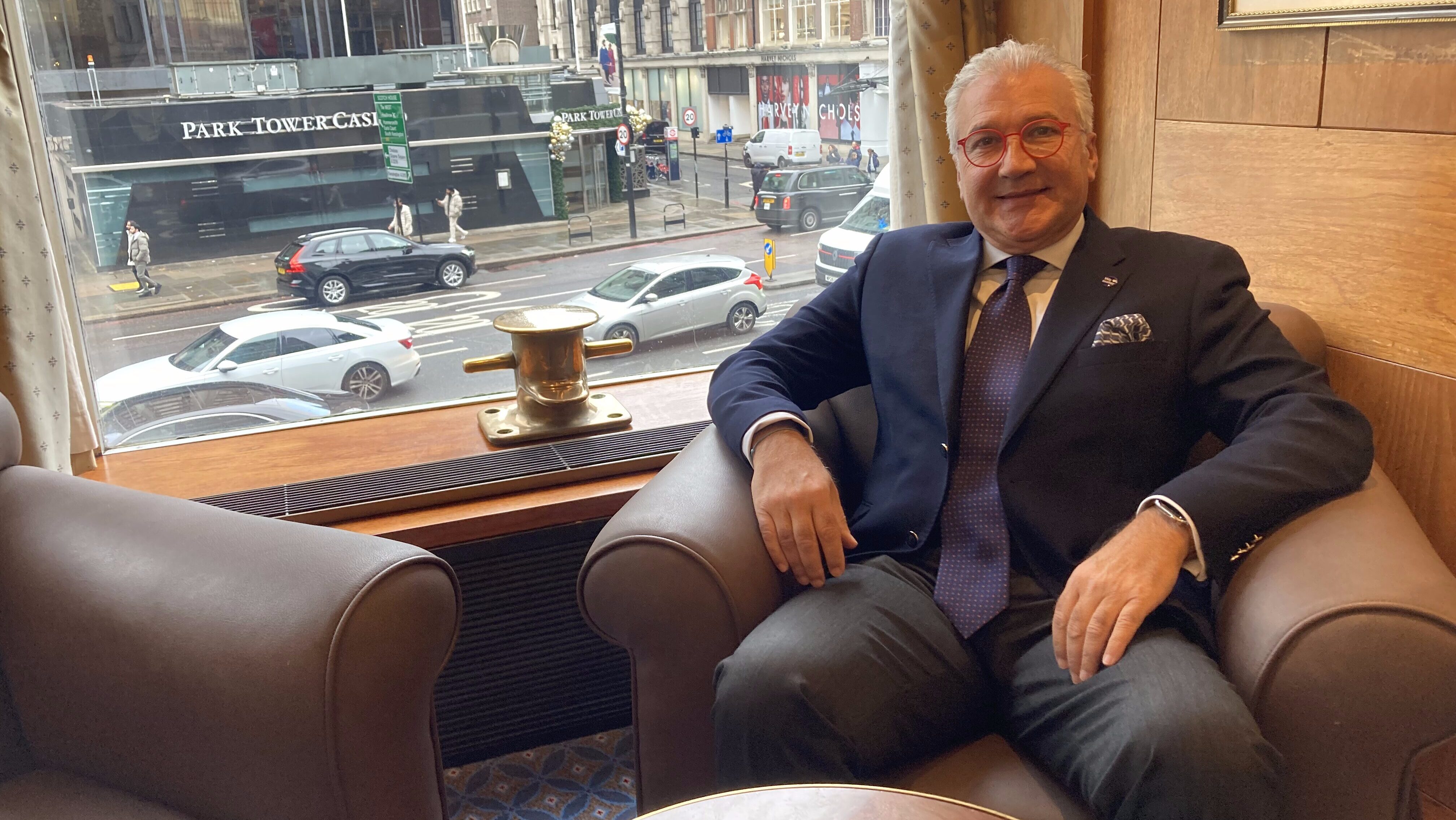
For Petros Michelidakis, show director at boot Düsseldorf, the answer is clear. Trade shows aren’t fading; they are evolving, becoming more community-driven, more strategic and more essential than ever.
From the blurred lines between B2B and B2C, to the rise of AI and the return of major exhibitors, Michelidakis argues that shows remain the “living market” where the industry resets itself each year.
And he very much hopes that no one has the time to read his thoughts on this during the days which boot Düsseldorf is open.
“I hope that they will be involved in talking with clients,” he says.
Comparisons between Metstrade and boot Düsseldorf come up every year, but Michelidakis is quick to clarify the distinction.
“Metstrade is a B2B show, and boot Düsseldorf is a B2C show,” he says. “We are B2B when it comes to boat dealers, for instance, when they want to come and see what’s around. But, I always say, in Mets you see all the things which make a boat at the end, but you see the boat in Düsseldorf.”
The latter, he says, benefits from being a community hub – where sailors, divers, charter operators, coaches and dealers all collide.
The ‘soft closing’ events introduced in 2025 proved how important that community is.
“They were running around searching for products until six o’clock,” he says, “and at six o’clock they all went to the stages for a happy hour beer or a coffee and meeting friends.”

AI isn’t replacing shows – it’s making them smarter
Community is precisely what’s needed when AI is reshaping everything else, from navigation
to customer behaviour. “AI is part of any segment of our life so, of course, also boating,” Michelidakis says.
“But in my opinion, it’s supporting a show, any show, not only ours, if we put the right information on the right platforms. I don’t think that a show will be influenced by AI because, as long as people are creating the shows, the shows are more and more personalised.”
Ultimately, shows remain human experiences, and that’s the point. “The target is always to have a personalised offer for the visitors,” he says. “The visitors in this case are the main target.”

Market trends: large yachts strong, but small boats are selling too
The industry has spent 12 months talking about larger yachts dominating sales, but Michelidakis believes the picture is more balanced than it seems.
“Large yachts are more in favour at the moment because the part of society that can afford them is spending,” he says. Rising financial costs, geopolitical uncertainty and the behaviour of politicians have made other buyers more cautious. He expects a rebound.
“People start thinking that they have one life, they want to be rewarded for the lifetime of work they have done,” he says. “Of course, they buy a boat, or they charter the boat they always wanted.
“This year, hall number three is fully booked – 20,000 square metres – with boats up to 10 metres.”
“If somebody has the right offer in the small boat section, he is doing business. Maybe not as much as during covid, but he is still doing business. The market will become better.”
Helping consumers fulfil dreams of owning a sailing boat
Research conducted by the organisers prior to the show indicates that many people desire a sailboat, but for whatever reason are unable to realise that dream.
Michelidakis says dealers and shows need to help them fulfil their ideal. Forty per cent of respondents to a survey (drawn from circa 80,000 who obtained German boat licences in 2024) said they took their licence so they could buy a boat, and of that subset, 53 per cent are looking at a sailing boat (both sailing halls are full).
“But what we know is that from the 53 per cent, we lose at least 40 per cent. Because at the end it’s 80 per cent [buying a] motor boat, 20 per cent sailing boat.
“They say, ‘in my head, I want to own a sailing boat’. At the end, they don’t. They own a motorboat.
“And the sailing boat industry is suffering at the moment, very much.”
Motor appears to dominate sail when it comes to getting new consumers into the marine world. “The easiest thing is to check your budget and go and buy a motor boat,” Michelidakis says. “That’s why motor boat is winning. It’s more convenient.”
This aggravates him. Michelidakis is very keen that the sailing sector is well supported, not least because he believes that those who learn to sail first are generally better mannered on the water.

How boot Düsseldorf supports builders in difficult times
The support the show offers boatbuilders is beyond logistics.
“The main support is the organisation,” he says, and marketing reach is a crucial
part of that structure.
“We have a media reach of 1.2 billion after boot Düsseldorf every year. Organisers track the strategies of exhibitors, then align their campaigns to those messages. The show also provides visibility for emerging sectors – particularly electric boats and alternative propulsion.”
Plus, he says: “We try to get the politicians there, the decision makers… so they understand how important it is, and they take the right decisions.”
boot Düsseldorf also focuses on attracting new water sports enthusiasts to help grow the long-term customer base. “These are the future clients of the shipyards. This is another way of helping.”
Exhibitors are returning – and new ones keep coming
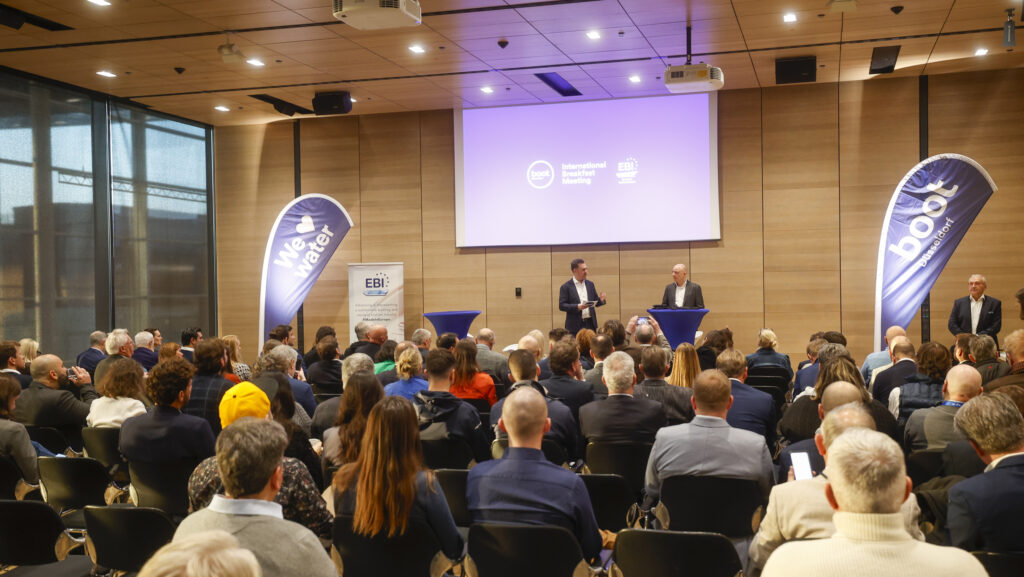
The 2025 edition saw a wave of new exhibitors, with many planning to return in 2026. Michelidakis reports that this pattern is continuing.
“We always have about 180 new exhibitors on every show – about 10 per cent of the total surface area. Some attend every second year, but the churn is healthy.”
And, crucially, several major names that skipped previous editions are back.
“Bavaria and Hanse,” he says. “Sunbeam is back… We have Bali catamarans, Lagoon back with catamarans. And we have also back fleet operators… and one big player in diving.”
The recovery of the charter and sailing sectors is especially meaningful. “Where we really had a problem was charter and sailing boats, and they are here now.”
But his closing message is more reflective.
“People sometimes are disappointed,” he says. “My wish is that the market is slowly coming back and that boot Düsseldorf will prove again that it’s an existing, alive market with good potential for the next years.”
The post boot Düsseldorf’s director on artificial intelligence, market shifts and the future of boating appeared first on Marine Industry News.
Leave a Reply