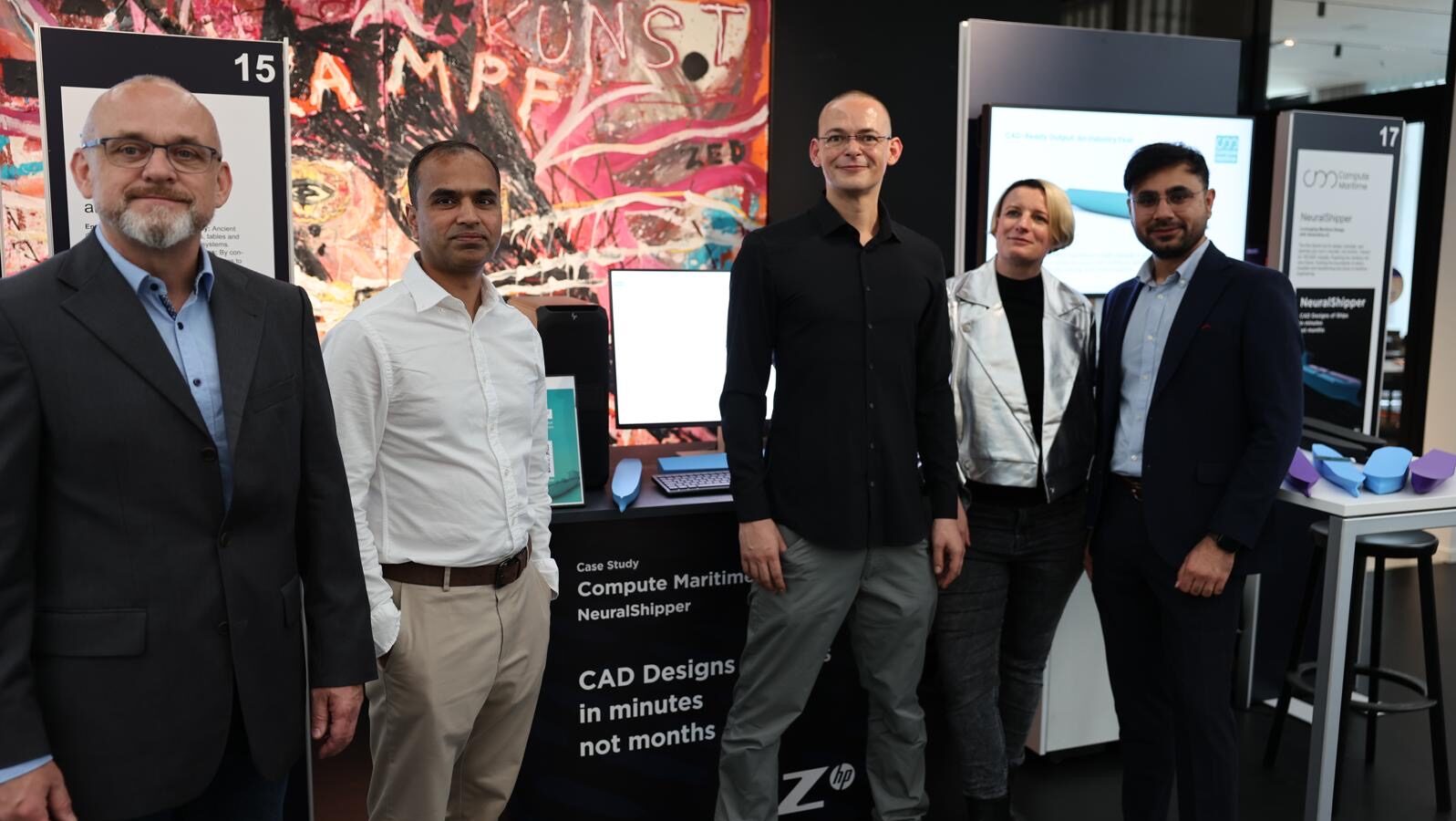
Compute Maritime is aiming to transform ship design and simulation and has developed ‘the world’s first GenAI tool capable of designing, simulating and optimising any type of ship hull’, its flagship tool; NeuralShipper.
Shahroz Khan, CEO, explains: “Compute Maritime is a deep-tech company using generative AI to overhaul the ship design process. Our core product, NeuralShipper, is an AI co-pilot that helps naval architects design and test vessels far more quickly and efficiently than current methods allow. We’re building an end-to-end AI-native ecosystem for the entire ship lifecycle, from initial concept to operational optimisation, to help the maritime industry meet its urgent net-zero targets.”
Compute Maritime’s target market is ship design firms, naval architecture consultancies and in-house design teams at shipyards and large maritime operators.
“We are initially focusing on the high-growth workboat and yacht segments, where innovation is adopted more readily. Our business model scales from small design firms to large enterprise clients, such as our key partner, Siemens.”
Compute formed a strategic partnership with Siemens Digital Industries Software in February 2025. The project focuses on connecting Compute Maritime’s flagship platform, NeuralShipper, with Siemens’ Simcenter STAR-CCM+ software for computational fluid dynamics (CFD) and
results validation.
“Our collaboration with Compute Maritime represents a paradigm shift in maritime design,” says Dmitry Ponkratov, marine director, simulation and test solutions, Siemens Digital Industries Software. “The combination of NeuralShipper and Simcenter STAR-CCM+ aims to redefine how multidisciplinary design optimisation is performed. It enables the creation of novel vessel types and demonstrates how designers can automate simulation processes and predict real-world performance, even for the most unconventional designs.”
Discussing the partnership, Khan notes: “[Siemens Digital Industries Software’s] foresight in recognising the transformative potential of generative AI in maritime design sets them apart. They haven’t just been a customer; they’ve been a true innovation partner, independently validating NeuralShipper’s capabilities and actively working to integrate our technology into their ecosystem.
“The feedback has been overwhelmingly positive.
“The director of marine at Siemens called NeuralShipper’s capabilities ‘astonishing’, highlighting its ability to dramatically reduce design workflows while improving performance.
“In one independently verified case study with them, our platform reduced a design task, that traditionally takes over a month, to just 4.37 minutes. Other early users report a 20 per cent faster design cycle, a 10 per cent reduction in design costs and a 50 per cent improvement in overall efficiency.”
The next goal is to evolve NeuralShipper from a prototype to a fully commercial, full-stack platform (achieving TRL 9). “This involves integrating our AI-driven design capabilities with simulation, optimisation and digital manufacturing into a single, seamless workflow. We aim to expand our client base to 75 enterprise customers, deepen our integration with major partners like Siemens, accelerate our pan-European market entry and begin developing adjacent products for hydrodynamic components and green retrofit optimisation,” Khan says.
Regulations driving AI interest
“The maritime industry is under immense pressure to decarbonise, with new regulations like IMO 2030 and the EU Emissions Trading Scheme imposing heavy financial penalties for high-emission vessels. However, ship design is still stuck in the past, relying on a slow, iterative process from the 1950s. This ‘design spiral’ methodology makes it incredibly time consuming and creatively draining to innovate and integrate new green technologies. 99 per cent of new ships are almost identical to those built 50 years ago.”
While some may argue with this point of view, NeuralShipper is certainly built to expedite the design process. “It allows designers to generate and test thousands of innovative, regulation-compliant designs in minutes, not months,” Khan continues. “This accelerates the adoption of green technologies (like alternative fuels and wind-assist) and ensures new vessels are built for maximum efficiency from day one.”
Khan says the startup’s biggest challenge to date has been the maritime industry’s “traditional conservatism and slow pace of technology adoption.
“It’s an antiquated sector, which means there’s a huge opportunity for disruption, but it also makes securing investment difficult. Traditional VCs are often unfamiliar with the industry’s nuances and are hesitant about its slower investment cycle compared to other tech sectors. This makes non-traditional funding, industry partnerships and proving clear, immediate ROI absolutely critical for us.”
While built specifically for the complex demands of the marine industry, the underlying foundation model for generating 3D geometry is highly transferable.
“We’ve already received unsolicited interest from the European Space Agency for potential spacecraft design applications and from the Volkswagen Group for automotive design exploration. For now, however, our strategic focus remains 100 per cent on maritime – a large, underserved and regulation-driven market where we can make the most immediate impact.”
Khan says exhibiting at trade shows and intiatives such as the Start-Up Pavilion at Metstrade allows the company to connect directly with naval architects, yacht designers and shipyards to demonstrate NeuralShipper’s capabilities live.
“We [want to] generate qualified leads for pilot projects, build brand awareness as pioneers in maritime AI, and gather direct feedback from potential users to help shape our product roadmap. We want to meet potential strategic partners and investors who share our vision for a more sustainable and digitally driven maritime future.”
The post ‘Astonishing’ AI system changing ship design gives update on Siemens partnership appeared first on Marine Industry News.
Leave a Reply